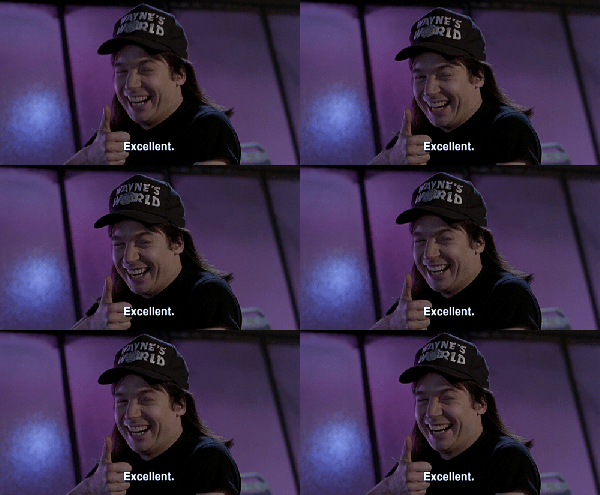
I made a meme! I’m officially a Geek!

So, I made one of those oh-so-clever Internet image memes based on a comment I made in my head last night watching ST:TNG with the Princess. So, in order to be able to post a link to it, I’m including it here for your viewing pleasure…

Engineering ala IT Crowd

You know he had to be thinking that sometimes…

Posted in Ramblings | Tagged , , , , | Leave a comment

Sgt. Pepper’s Lonely Hearts Club Band, or WTF Were They Thinking?

Sgt. Pepper's Lonely Hearts Club BandSo, having nothing better to do on a Wednesday night, I cued up the old Netflix queue and decided to try out this film I had heard about but had never experienced: Sgt. Pepper’s Lonely Hearts Club Band.

Have. Left. The. Words. Me.

What an utterly bizarre mishmash. Covers that (with one definite, and one possible, exception) should never have been attempted. A rambling pseudo-plot that doesn’t make enough sense to be called surrealist.

I could go on and on. So, let’s just do a “WTF” list of the top weird things in this…this…I don’t even know what to call it…

  1. Peter Frampton‘s acting: When was he going to “come alive”? 
  2. Barry Gibb‘s hair: That magnificent mane, that glorious coiffure; it needed its own acting credit. I haven’t seen a head of hair steal a movie like that since The DaVinci Code
  3. Really, George Burns? Really? Had the “Oh, God!” money run out?
  4. Steve Martin channeling Boris Karloff for “Maxwell’s Silver Hammer”. I can’t get it out of my head. Short of using a hammer. Oh the irony.
  5. Billy Preston raising the dead with laser beams. Laser beams! And they gave him a trumpet to do it? If he had used a keyboard, I could have bought that…
  6. You have singing robots with electronic voices and you don’t think to just have Pete Frampton “talk box” the part? Wasted opportunities…
  7. Okay…so the town everybody wants to save is Heartland, America. But all the good guys are British and the bad guys are American. Weird, huh?

    Donald or Ringo

    Donald Pleasence or Ringo Starr? I’m still not sure…

  8. I totally don’t buy that the Bee Gees and Peter Frampton beat Aerosmith up. That just can’t happen in this universe.
  9. Okay, I admit it. At first I thought Donald Pleasence actually was Ringo Starr
  10. What the hell ever happened to Lovely Rita, the Meter Maid? Huh? What has Mean Mr. Mustard done with her? Seriously–you manage to work in a guy named “Sunk” who dropped the ‘k’ to become the Sun King but you couldn’t work in a lousy traffic enforcement officer? 

So anyway, enough of that. I just had to get it off my chest. And then I cleansed my palate with some Humble Pie and Uriah Heep

Because I don’t have any silver hammers laying around and I’ve punished myself enough.

Posted in Ramblings | Tagged , , , , , , , , , , | Leave a comment

Review: x0 by Sherrie Cronin

x0 (Power of Zero)x0: An Interactive Novel by Sherrie Cronin (9780985156183) : Cinnabar Press/Smashwords (2012)

Lola Zeitman is an accomplished oil & gas industry geologist, as well as a devoted wife and mother to three children. She is also discovering that she is a nascent telepath and that a woman she has never met desperately needs her help. In Nigeria, a young woman called Somadina has discovered that her ability to “read” people, a talent that had lain dormant since her childhood, has returned and that her sister, Nwanyi, may be not only be locked into an odious marriage arrangement, but may also be in great danger. The two women, drawn together by mutual bonds of ability and need, find that not only are they not alone in their empathic abilities, but that they must save not only Nwanyi, but the unsuspecting victims of a terrorist plot.

The novel (the title of which can be stated as “to the power of zero”), is cited as an “interactive” novel. There are hyperlinks throughout the text that refer the reader to various sources of further information: pronunciation guides, background music references, photographs, opinion pieces, and the like. According to the “A note to my readers”, these links will be monitored for breakage and updates will be found at the website established to promote the book (and the upcoming sequels). In practice, the format veers away from the non-linear, “choose-your-own-adventure” style of other interactive novels book and, instead, maintains a traditional linear narrative that simply gives the reader outside opportunities to enhance the experience and explore. This actually works fairly well–especially for readers (such as myself) that often spring to the keyboard to search for various bits of interest we encounter as we read. And for those that lack an e-reader with the ability to follow hypertext, the reader is provided enough contextual clues to ensure that the links are not necessary to understand the plot.

Cronin maintains a fairly brisk pace and manages to juggle multiple points of view and storylines with practiced skill. The principle characters are well-drawn, interesting, and sympathetic. The antagonist, the coldly calculating Djimon, is particularly chilling–clinically ruthless and blindly self-righteous. Further, it’s clear that the author has done extensive research into the various cultures and industries she describes. The plot clicks along on its own momentum and wrestles with worthy themes of acceptance, human interconnectedness, and cross-cultural communication. The ways in which Cronin presents telepathic communication–as well as the implications for its existence–are well-executed and just plain interesting. She does a good job of imparting a layman’s understanding of complex philosophical and metaphysical ideas.

There are, however, a few nits that need to be picked. At the beginning of the novel, the author tends to provide parenthetical guides to the pronunciation of various non-European names–guides that interrupt the flow of the story and serve to take the reader out of the text. In fact, it would have been more appropriate to use a hyperlink on the name instead of the in-text notation. Further, this book does have a lot of info-dumping; all of it necessary to the plot, but still daunting. However, Cronin handles the large amount of contextual information well and seldom loses the reader during those sequences.

While the character of Lola is well-drawn and likable, I found that the character of Somadina and her story were far more interesting–in fact, I think that Somadina would make a fine hero for a novel in her own right. There is also the problem of the climax which, while suspenseful, edges uncomfortably close to paternalism. The story would have been better served if Somadina had taken a more active role in the final events.

Nevertheless, x0 is a fine, enjoyable read for those interested in some intriguing notions on the nature of telepathy and an ultimately optimistic story with characters you can root for. And for those that want more, the novel is slated to be the first in a six-book series.

Posted in Reviews | Tagged , , , , , , | 3 Comments

Big Feet: A Lesson in Privilege

http://dovebridge.files.wordpress.com/2009/11/foot-in-mouth-xray.jpg?w=400&h=400Yesterday, John Scalzi had an excellent piece on privilege entitled “Straight White Male: The Lowest Difficulty Setting There Is“. I think his metaphor is particularly apt and can help explain one of the stickier problems in speaking about issues of race, gender, class, etc. With this in mind, I want to share a lesson that I’ve learned recently about privilege and how not acknowledging it can, at the least, cause embarrassment, and the at the worst, cause harm.

I was recently participating in the comment thread of a blog forum in which a group of authors from various non-Western cultural backgrounds discussed the numerous ways in which Western/White authors essentially “get it wrong” when it comes to creating stories based on cultures outside of their own experience, as well as the frustrations that come with that. It was very illuminating and some very good points were being made, as well as some to which I had some questions. And, I thought, as civil discussion can often bring about understanding, I decided to voice some of my questions and observations in the comments.

And this went over like the proverbial lead balloon.

This is because, as I realize now, members of the privileged classes have to remember that they have big feet. And as such, we can often blunder into spaces where we are, despite the best of our intentions, stepping on and into places we do not need to.

It’s just not helpful.

Whether or not my points were cogent or applicable is irrelevant. The “rightness” or “wrongness” of my comments only really mattered if the purpose was winning points or winning a debate–which was not the point at all. I could have made the most conclusive and prescient point since the days of the ancient philosophers, but it doesn’t matter. Because the point of my joining the discussion was to help the situation or to help in understanding, and it was clear that my participation wasn’t doing that.

I jumped in with a big, dumb, smile on my face, hoping to make some friends, and got my big, dumb, clodhoppers all over everything. As Scalzi often puts it, I showed my ass.

So, all I could do at that point was acknowledge it, offer an apology, and walk away. And whether or not the apology was accepted or not is irrelevant–it was something I needed to give.

As a member of a undeniably privileged class, I want to be a good citizen of the world. I want to help in making the world a better place and promote understanding between people based on our common humanity. As a speculative fiction writer/reader, I believe that having a more diverse market of stories and visions helps the genre evolve and progress. It just makes it better. These are all things I sincerely believe in.

But as a member of that class, I have to watch where my big feet are going. I have to remember that the voice of “my side” of the story is not always part of the discussion, not because it’s not being heard, but because it is heard all too often. I have to remember that sometimes it is better to listen than to comment; even if my thoughts come from a place that seeks understanding, I have to look and see if they are helpful to the conversation.

As Mark Twain said: “It is better to keep your mouth closed and let people think you are a fool than to open it and remove all doubt.”

Posted in Ramblings | Tagged , , , , , , , , | 3 Comments

Cheaters Never Prosper

Cabin in the Woods

Don’t ruin the game by buying the cheat codes…

Okay…in trying to be a good internet citizen, and in the event that you are one of those rare people who would be inclined to watch the Drew Goddard/Joss Whedon film The Cabin in the Woods and still haven’t seen it yet, there will be spoilers ahead. No worries, though–I will give you ample warning.

First of all, I think that The Cabin in the Woods is probably one of the most clever films that I’ve seen in a long time. It is hilarious, fun, genuinely scary, and just plain cool. Like Scream back in the 90s, it does an excellent job of turning the “slasher flick” on its severed ear.

There are several elements that contributed to why this worked so well. The writers clearly knew their source material and played in the tropes of the genre like artists play in colors. The dialog (as per usual in a Whedon production) was snappy and revelatory. The movie wasn’t a comedy, but was also laugh-out-loud funny–a fine line that results in a scary film in which you actually care about the characters and the horrible things that happen to them. The central idea was clever and well-executed. All of these elements came together like a well-oiled machine that rocketed viewers toward a climax that delivered.

And that is the most important part of the puzzle. They didn’t cheat on the ending.

SPOILER WARNING * SPOILER WARNING* SPOILER WARNING

THERE BE SPOILERS AHEAD, MATEYS! WATCH WHERE YE POINT YER JIB!

SPOILER WARNING * SPOILER WARNING* SPOILER WARNING

There…that ought to do it. Now we can speak freely…

The writers really painted themselves into a tight corner–especially for a Hollywood film. The movie could really have ended in only two ways: one of the two main characters must kill the other in cold blood to be the hero or the earth is overrun by Lovecraftian horrors. Not a good situation for a film being played to audiences that typically revolt if the hero doesn’t win and the bad-guys don’t get their comeuppance.

Usually what happens is some lame last-minute fix is shoehorned in to pull the writer’s fat out of the fire. Some character we thought was dead emerges and saves the day. The cavalry is called in and the place is overrun with FBI agents and black ops soldiers. The heroes think of some secret vulnerability in the Big Bad that can exploited to a rousing, bombastic, conclusion. Anything to keep the ending from being “too depressing” or some such nonsense.

But Goddard and Whedon didn’t cheat. The two characters stayed true to their personalities, maintained their basic humanity, and let the world come to an end.

A stupid, tacked-on ending would have eliminated all the crunchy awesome created by the other elements of the movie. It would have rendered the whole enterprise a complete waste of time and energy. It didn’t cheat the characters, it didn’t cheat the story, and it didn’t cheat the audience.

It’s a lesson that so many other writers need to learn: cheaters never prosper.

Posted in Ramblings | Tagged , , , , , , | Leave a comment